
Socializing With An Autistic Person
Things to keep in mind by Remrov
My name is Remrov and I have classic autism.
When I write about autism I always start by saying that no autistic person is the same, but we do have a lot of difficulties in common. More and more people are diagnosed with autism lately. I believe that this is not because there are more autistic people than twenty years ago, but there’s a lot more knowledge about it, so it’s recognized a lot easier.
I see it as a good thing that more people are being diagnosed, because they don’t have to go through life wondering why everything is such a struggle for them, like I have been doing the first twenty-one years of my life. There’s a big change that you have, or will have, an autistic person in your social network, and when socializing with that person it is good to keep a few things in mind.
Socializing in the first place can be very difficult for autistic people. This has a few different reasons.
>

Sex Ed Mart materials have been specifically adapted to help teach these concepts and more to individuals with intellectual differences, developmental delays and Autism Spectrum Disorders.
>
The first reason is communicating. Communicating doesn’t go automatically with many autistic people. Many of of are image thinkers. In our minds we have to translate spoken words into images, so that we understand what you are saying. When we communicate back to you we have to do the same. This can take some time and it is also tiring. It is good to have a bit more patience when talking to an autistic person.
<
This game helps students create connections and new friendships between classmates, and assists students in identifying the commonalities with their peers.
>
Another reason why socializing can be difficult is sensory sensitivity. Many autistic people struggle with sensory issues. All kinds of sensory input for our environment come in extremely hard and all at the same time. We can’t filter out sensory information that is important to us. Every detail is sensory input is just as important, and processing everything all at once can be extremely overwhelming.
Let me take a dinner party as an example:
A dinner party is something that I haven’t been part of very often, because I find it too difficult. During a dinner party there can be many people present. And the more people there are, the more conversations go on at the same time. When I’m in a big group, it is almost impossible to have a conversation myself. I hear all the other conversations just as loud, and I can’t filter out the voice of the person I am talking too.
In a situation like this you might notice that an autistic person won’t say anything, or won’t interact with anybody. This is not because we don’t want to have a conversation, but it’s too difficult for many of us.
It is good to be aware of this and try to keep your voices down a bit, or to have only one conversation with the whole group, in which the autistic person can participate.
>

This game teaches young students to look at body language and match the emotion the person is feeling which s is a critical part of all relationships.
>
The location of a dinner party is also important.
It it is at somebody’s home, we do not have to worry about many other noises than the ones the people make at the dinner table.
A dinner party in a restaurant on the other hand, will be more chaotic because there are many other people having conversations as well. In situations like this it might be a good idea to invite an autistic person to go outside for example, to have a conversation one on one.
Another thing to keep in mind is that many autistic people take language very literally.
During parties people often like to joke or to use metaphors. You might notice that an autistic person is the only one not laughing when a joke is made, or that he or she will take a metaphor too literally. A good thing is to take this under consideration and to adapt your use of language a bit.
<
This activity seeks to promote reflection about what children are comfortable with and teaches children that it is okay to say, “Stop”.
>
One other thing that is very important to know is that many autistic people do not like to be touched.
Tapping people on the shoulder, tickling, splashing water — things that can be funny for many people, but can be very agonizing for an autistic people, and a reason to get upset.
There are also autistic people who will pretend they liked it because they want to fit in, but nonetheless they definitely do not enjoy it. It is good to take this under consideration and not do this to an autistic person.
Autistic people want to be part of things; they want to have friends and fun like everybody else. But some adaptions need to be made. If everybody understands this and takes this under consideration, a party can be fun for everybody and autistic people can participate instead of staying at home.
Below is a youtube video that Remrov produced:
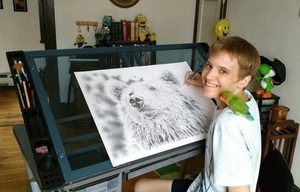
If you like to see Remrov’s drawings, please visit hiswebsite: www.remrovsartwork.com
If you like to learn more about the services Remrov provides, please visit this website: www.remrovsautism.weebly.com



Leave a Reply